
If you are thinking of starting a family
If you are thinking of starting or expanding your family, or are pregnant and would like more information, you can contact your regional genetics service. You can be referred by your GP or another healthcare professional such as your ophthalmologist or paediatrician.
If a genetic cause for the MACS condition is known your specialist doctor or genetic counsellor will be able to advise you of the chances of further children having related genetic conditions. There may be several options available to you:
- You do not have to do anything; you can choose to become pregnant and not have any intervention with the understanding there is a chance of having a child with the condition.
- You may choose to become pregnant naturally and have prenatal genetic testing. This is invasive testing in the pregnancy to see if the foetus has inherited the known gene change.
- You may also choose surrogacy, or to adopt or foster children.
- Genetic testing prior to a pregnancy may also be available, this is a specialist form of in vitro fertilisation (IVF) known as preimplantation genetic testing (PGT). PGT is a process which involves testing fertilised eggs to see if they have the gene change. Couples can receive up to three fully funded cycles but eligibility for PGT is based on a short criterion which your specialist doctor or genetic counsellor can speak to you about in more detail and let you know if you are eligible.
If a genetic cause for the MACS condition in your family is not known your genetics doctor will still be able to give you information on the chance of having a child with a MACS condition, however genetic testing prior to or in a pregnancy will not be available.
Please note this information may change over time and your regional genetics service will be able to provide you with the most accurate and up to date information
How genes changes can be passed on
A genetic condition is due to a change in a gene or on a chromosome, where multiple genes are stored. These changes can be passed on or inherited from a parent, or occur for the first time in that individual which is called a “de novo” change. “De novo” is a Latin term that means new.
Everyone has two copies of each gene, one inherited from their mum, and one inherited from their dad. Genetic conditions can be passed on, also called inherited, in different ways depending on where the gene change is located and how many copies of the gene have changes. The different types of ways MAC conditions have been found to be passed on in families are:
- Autosomal dominant
- Autosomal recessive
- X linked
Your genetics doctor or genetic counsellor will be able to explain to you how the gene change can be passed on in your family.
Please note that some genes and their inheritance patterns are well known, while other, more rare gene changes and how they are passed on is not yet understood.
Autosomal dominant
This pattern of inheritance is used to describe when a change in just one of the two copies of genes (one from mum, one from dad) is enough to cause a condition. The condition can be passed down from either parent.
When a person with an autosomal dominant condition has children there is a 50% or 1 in 2 chance of passing on the gene change causing the condition. This is random chance for each pregnancy, regardless of the sex of the baby. Some families may have three children and all three have the condition, or they may have three children and none of them have the condition. There is no way to predict this. For some families there can be feelings of guilt when genetic changes are passed on in families, but it is important to consider that we do not control which genes we pass on to our children, just as we did not control what was passed to us.
The diagram below explains dominant inheritance. As genes come in pairs, each parent passes on only one of their genes. The parent without the gene change will only pass on working copies of the gene. While the parent with the gene change will either pass on a working copy, or the copy of the gene with the change.

Recessive inheritance
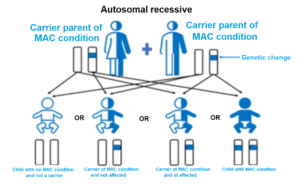
In autosomal recessive condition, both copies of the gene(s) causing the condition have a change. Parents typically do not have the condition as they will have one copy of the gene with a change and one working copy which compensate for the non-working copy, these parents are called ‘carriers’ of the gene. Therefore, for a child to be affected with an autosomal recessive condition, both parents need to be carriers of the same gene change.
If both parents are carriers of a MAC condition, there is a 25% chance (or 1 in 4) that their child will have the condition. There is a 50% chance (or 1 in 2) that their child will be a carrier and not have the condition and there is a 25% chance (or 1 in 4) that their child will not be a carrier and not have the condition.
X linked
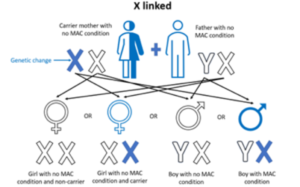
This form of inheritance is called X linked because the gene change occurs on the X chromosome. Females have two X chromosomes (X X) and males have one X and one Y chromosome (X Y) which determines the sex of the individual. When a woman has a change on her X chromosome she is not affected with the condition because she has another X chromosome to compensate. When she has children there is a 50% or 1 in 2 chance, she will pass on the gene change. However, how that gene change may affect children depends on their sex.
As males only have one X chromosome, if they inherit an X chromosome with a gene change, they do not have another X to compensate and so have the condition. While female children have another X chromosome and so are not typically affected with the condition but are carriers.
The diagram below shows that if a female carrier has children there is a 50% chance of having a boy with the condition and 50% of a boy who does not have the condition and cannot pass it on. There is a 50% chance of having a girl who does not have the condition but is a carrier and a 50% chance of having a girl who does not have the condition and is not a carrier.
Your genetics doctor or genetic counsellor will be able to speak about this in more detail whilst taking your personal medical information and family history into account.
Please note information changes over time through advances in knowledge and technology, and new genes being found to be associated with MAC conditions may follow different patterns of inheritance.
More on genetics
Head over back to the information on your genetic journey.