
Photo Credit: Simon Pizzey, www.gloucestershirelive.co.uk

Photo Credit: Simon Pizzey, www.gloucestershirelive.co.uk

Photo Credit: Simon Pizzey, www.gloucestershirelive.co.uk
Congratulations to Danny Barthorpe and Marcus Tyler!
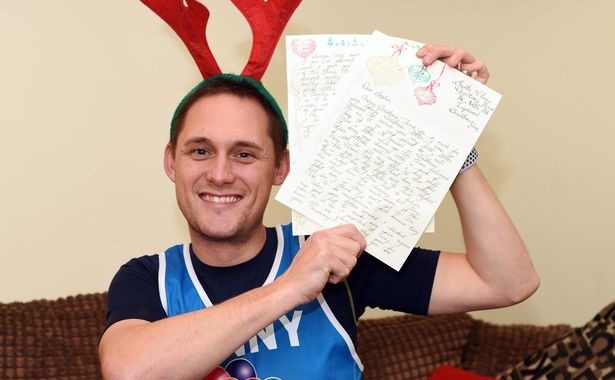
We are delighted to announce our Fundraisers of the Month in December, Danny Barthorpe and Marcus Tyler. Danny and Marcus have been writing and hand-delivering Letters From Santa in their local area, as well as catching the attention of the local newspaper, Gloucestershire Live, which has further helped attract interest allowing them both to raise an incredible £1,168 for MACS so far! We caught up with Danny to find out a bit more about the letters.
Hi Danny, Congratulations on being our Fundraiser of the Month! Could you tell us a bit about your fundraising idea?
For years I have been hand writing my children’s letters from Father Christmas with personalised content and full of Christmas magic. I thought it would be nice to offer this service to others in return for a small donation. Even better than this, I managed to persuade my friend to do it too! As we are both training for the marathon, all letters are hand delivered and will form one of our training routes!
That sounds amazing! What is it like to be Santa?!
When a parent comes to us we ask them to tell us about the child's achievements and milestones over the past year. We also ask names of pets and family to add that in too. Sometimes if I know the parent of the child, I have written and told them that their mum or dad was once on the naughty list and give a comical reason as to why. It is a bit of added fun.
Sometimes the parents have also asked me to remind their child it is not all about what they will get and to remember that Christmas is a time for family. There have been some really very heartfelt requests of messages that the parents have wanted to get across to their children and no one has been disappointed.
How many have you written so far? Did you notice a rush of requests after the newspaper article has been published?
We noticed a lot more requests from further afield after the newspaper article. So far we have sent letters all over Gloucestershire and Cornwall, some have even gone as far as Wales!
In total we have produced 103 letters to date between us both. Sadly, because every letter takes about an hour to produce from start to finish, we have had to stop the service to ensure all letters are ready in time for Christmas.
What was it like to have the reporter at home interviewing you and filming? Would you encourage other fundraisers to try and contact their local newspapers? Do you have any tips?
The reporter was fab! They made me feel very at ease. They made me feel so at ease that before I knew it I was dressed in my running gear, wrapped in tinsel with Reindeer antlers on my head. We were all laughing.
They were very professional and helped so much with what to do and say. I would 100% recommend contacting them, they were more than happy to do anything to help raise awareness and money for the charity.
Well done again and congratulations! We wish you all the best for the London Marathon and look forward to seeing you at the finish!
This has been a very strange experience. I never expected just a few letters to raise so much! People have been very generous and willing to donate extra which is a testament to the good work and help you provide at MACS. Can't wait for the London Marathon now!
You can find out more about Danny’s letters here: https://www.facebook.com/santaletterforMACS
Read the full newspaper article here: https://www.gloucestershirelive.co.uk/news/gloucester-news/meet-man-delivering-letters-from-2255198
Special mention to Jude Ackerman and Anna Butler, who also stood out in their fundraising this month! You are all amazing and everyone at MACS is grateful to have such special fundraisers supporting us.
If you would like to enter next month's competition please email fundraising@macs.org.uk with your story.









 Our members know the difference that MACS has made to their lives, so it’s fantastic that the impact MACS is being recognised nationally. As well as training, advice and