


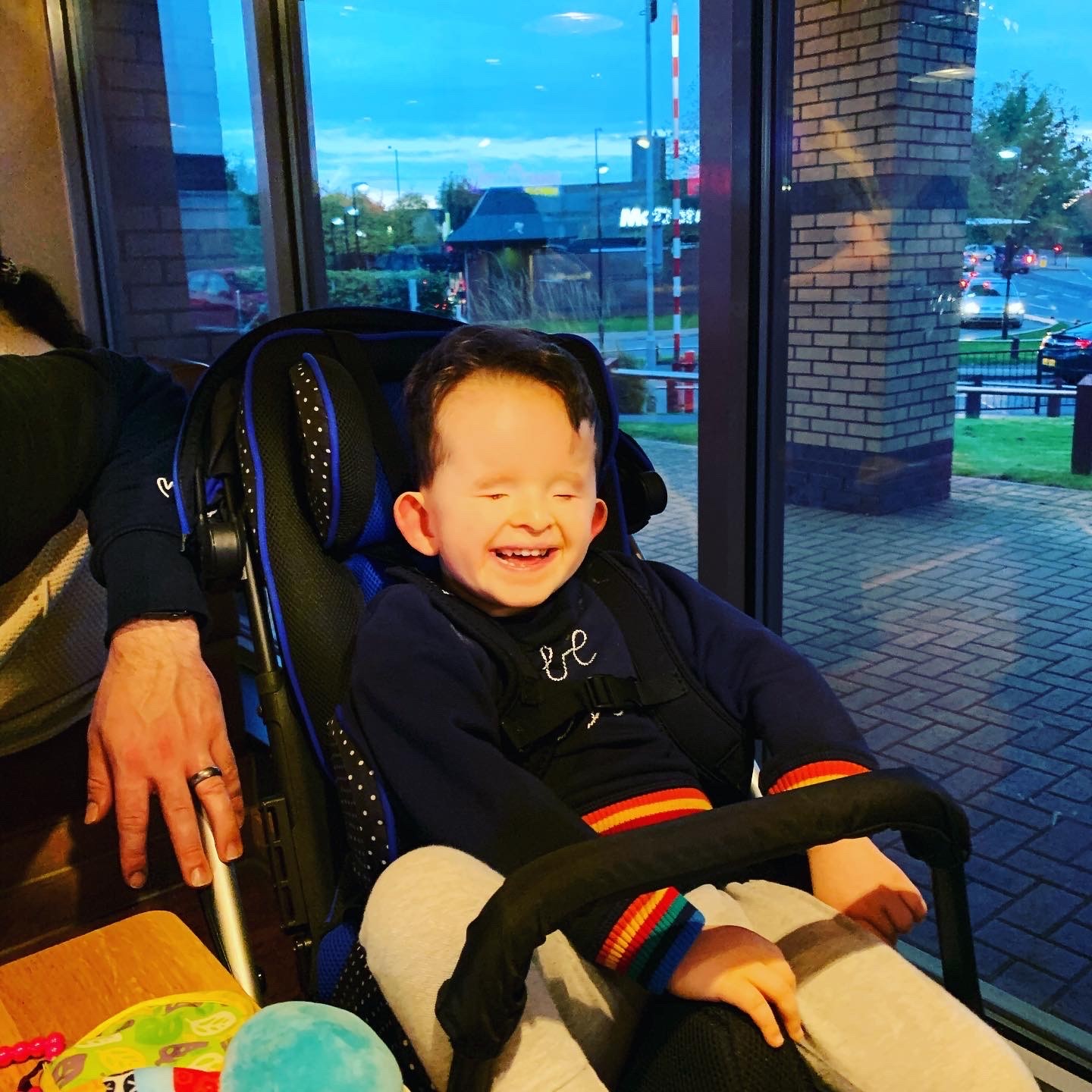
After a straightforward pregnancy, and with nothing flagged up from ante-natal scans, new mum Sarah Smith wasn’t expecting there to be any problems with her first child. But when Ted arrived after an emergency caesarean, his face was really swollen.
Sarah, 32, from Lincoln, says: “I noticed a midwife walking under a light trying to get Ted to open his eyes. Then a midwife called my husband Ben over and asked if he could also see there was nothing where Ted’s eyes should be. The paediatricians had never seen this before. We were totally shocked and devastated.”
Ted was born with a condition called bilateral anophthalmia – he was missing eyes, eye tissue and the optic nerve. As this condition is often linked to a fault on the genes linked to eye development, blood samples were sent to Nottingham City Hospital for genetic testing. Ted was kept in Lincoln Hospital for eight days to establish feeds on a nasogastric tube. Meanwhile, once home, the next few months were consumed with the challenge of feeding Ted, who had very bad reflux.
Sarah, an accountant, says: “We were back and forth to hospital as Ted wouldn’t feed. We were trying to keep Ted alive. We searched on the internet, but we really couldn’t find very much about his symptoms. At eight weeks old, Ted was seen by eye specialists at London’s Moorfields Hospital and we were linked with a family liaison staff member who gave us lots of leaflets for the charity MACS (Microphthalmia, Anophthalmia and Coloboma Support).”
When Ted was 12 weeks old, Sarah and Ben, 37, a civil engineer, received the results of the genetic tests. Ted has Sox2 anophthalmia syndrome, caused by an unbalanced translocation of Chromosomes 3 and 14 and a microdeletion of Chromosome 3.
“In simple terms these Chromosomes are snapped, swapped and a piece has gone missing,” Sarah explains. “My husband and I are not carriers; our tests were completely normal. It is so rare it occurs in one in 250,000 people. We asked the geneticist if it affects life expectancy, but as it is so rare, they just don’t know.”
These faults are on the genes responsible for eye development and the development and functioning of the pituitary gland. Ted’s brain development was also affected. He has an underdeveloped Corpus Callosum (which is a nerve that links the left and right hemispheres of the brain). It means Ted has global development delays, he is non-verbal, and he is very slow to meet childhood milestones.
Sarah says: “Ted seems to be at the extreme end of the scale for genetic anophthalmia. He is not mobile. He started having weekly physiotherapy sessions at four months old as he wasn’t lifting his head. He can now roll over, but we need to place him onto all fours and support him in a sitting position. He can’t bear any weight on his legs to stand. He is quite happy lying on his playmat, playing with his toys, and in his specialist seating.
“He has just had his 20th operation, 17 of those have been on his eye sockets. The first operation was at just eight weeks old, as he had no eye socket, just a slit. Surgeons inserted hydrogel expanders, to expand into sockets. Every three to four months he has had surgery to put a bigger expander in. He copes very well with all the operations, but he is very prone to infection, he has a weaker immune system and has had sepsis.”
A year ago, Ted had prosthetic eyes fitted – larger eyes are fitted in each operation. In February 2019, Ted had a setback when his right socket rejected his eye, as it couldn’t hold the weight. In May he had fat taken from his abdomen and skin from the top of his palate to strengthen the socket in his right eye.
Sarah explains: “All the eye operations are so important because the eyes and the eye sockets keep the structure of the face. The risk is the skull can collapse over and not grow properly. You can really see the difference after the operations. Sometimes the visual impairment is not the most difficult thing to cope with. Eating and mobility have been the most challenging for Ted. He can be very sick and have problems with his bowels. He also has problems sleeping and takes melatonin.”
Ted started part-time at a special needs school in September 2018, in a class which has some other children who are also blind. He now attends full-time and he loves school. He has hydrotherapy, speech and language therapy and rebound therapy on a trampoline.
“He is called ‘smiley Ted’ at school,” Sarah says. ““Ted loves movement, especially bouncing. He likes listening to music and likes to go out in his buggy.
“The charity MACS has helped us in so many ways. Providing practical support, a much-needed family break in Cornwall, and the links to make lifelong friends with other families affected with the same or similar conditions. It is really hard as a parent of a child with bilateral anophthalmia. We know he will probably never have any independence and he will rely on us for his care. We try not to think too much. We do all Ted’s care ourselves and we are lucky to have good family support, particularly from Ted’s two grandmothers. We have just made an appointment for a wheelchair and he is getting a hoist to make it easier to move him from the floor to a chair.”